




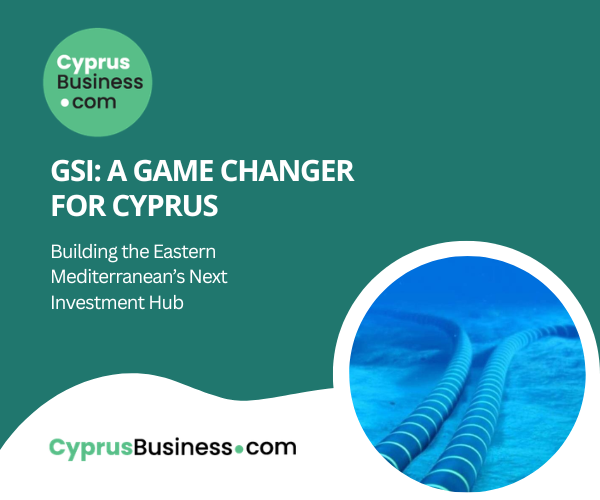
Greek Deputy Foreign Minister Harry Theoharis says the Great Sea Interconnector could transform regional energy security while closer cooperation in technology, trade and investment creates new opportunities for both countries.
Greece and Cyprus have the potential to develop into a regional hub for energy, investment, technology and resilient supply chains, according to Greece’s Deputy Minister of Foreign Affairs, Harry Theoharis.
Theoharis, who is responsible for economic diplomacy and international business development, highlighted the expanding scope of cooperation between the two countries during an official visit to Cyprus.
His programme included meetings with Cyprus Foreign Minister Constantinos Kombos and Energy, Commerce and Industry Minister Michael Damianos, alongside discussions with representatives of Invest Cyprus, the Cyprus Chamber of Commerce and Industry, the Cyprus–Greece Business Association and the wider business community.
GSI Could Transform Cyprus’s Energy Position
The Great Sea Interconnector is expected to be central to the next phase of economic and energy cooperation between Greece and Cyprus.
The planned subsea electricity connection would link the electricity networks of Greece and Cyprus, with the prospect of a subsequent extension to Israel.
Theoharis described the project as a “game changer” capable of ending Cyprus’s energy isolation, strengthening security of supply and supporting the greater use of renewable energy sources.
For Greece, the interconnector could reinforce the country’s role as an energy gateway connecting the Eastern Mediterranean with the European market.
Theoharis said the project had entered an important new investment and financing phase, noting that Meridiam’s involvement as a majority shareholder could provide additional financial and investment momentum.
European, French and US support for the project could also strengthen its international importance and improve the conditions for its development.
Beyond its immediate energy benefits, the GSI has wider economic and geopolitical significance. A functioning electricity link would increase regional connectivity, support energy-market integration and create a foundation for further infrastructure and investment projects.
Strong Trade and Investment Relationship
Economic relations between Cyprus and Greece already operate from a strong base.
According to Theoharis, Cyprus was the third most important destination for Greek exports in 2025, while Greece remains the largest supplier to the Cypriot market. Cyprus has also traditionally been one of Greece’s leading investment partners.
The movement of businesses and capital between the two markets has increased in recent years, with Greek companies investing in Cyprus across retail, services, technology, energy, healthcare and education. Cypriot businesses have similarly expanded their operations in Greece.
The increased presence of Greek banking institutions in Cyprus could provide further support for bilateral investment, business financing and joint expansion into international markets.
Opportunities Across Traditional and Emerging Sectors
Theoharis identified several sectors in which cooperation could be strengthened.
Established industries such as tourism, shipping, agri-food, healthcare and construction continue to provide a solid foundation for commercial relations. Further opportunities are emerging in pharmaceuticals, cosmetics, construction materials and other export-focused industries.
Technology represents one of the most important areas for future growth.
Cyprus and Greece already cooperate in digital governance and cybersecurity, while joint initiatives involving artificial intelligence, data infrastructure and AI Factories could improve their technological competitiveness and help attract higher-value investment.
Both countries benefit from specialised workforces, growing innovation ecosystems and strategic access to European and regional markets. Combining these strengths could support new investment in areas including:
- Artificial intelligence and digital infrastructure
- Data centres and cloud technology
- Cybersecurity
- Energy and renewable infrastructure
- Financial and professional services
- Shipping and port technology
- Healthcare and life sciences
- Research and innovation
Closer coordination between Invest Cyprus, Enterprise Greece and business organisations could help turn these areas into more structured investment propositions.
Joint Expansion Into Third Markets
The partnership also creates opportunities for Cypriot and Greek companies to cooperate outside their domestic markets.
Businesses from the two countries could combine their networks, expertise and regional experience to pursue opportunities across Southeastern Europe, the Middle East, North Africa and Asia.
Existing cooperation frameworks involving Israel, Egypt and Jordan already cover energy security, ports, cybersecurity, tourism, environmental protection and civil defence.
The India–Greece–Cyprus Business and Investment Council also provides a platform for developing investment and commercial relations with India.
Theoharis said the two countries could undertake joint promotional activities, participate together in international exhibitions and coordinate their approach to selected overseas markets.
Such cooperation could be particularly valuable for smaller and medium-sized companies seeking international expansion but lacking the resources to enter complex markets independently.
Cyprus’s Role in Regional Connectivity
Cyprus’s location between Europe and the Middle East gives it an important role in emerging regional energy, trade and digital networks.
The restructuring of global supply chains and continued geopolitical instability have increased demand for secure and diversified routes connecting Asia, the Middle East and Europe.
The India–Middle East–Europe Economic Corridor could become an important part of this changing landscape. Greece has the infrastructure and ports required to connect regional trade flows with Europe, while Cyprus offers strategic proximity to the Middle East and strong diplomatic and commercial relationships across the region.
Theoharis said the two countries could play complementary roles in connecting the corridor with European transport, energy and digital infrastructure.
Cyprus also launched the Friends of IMEC initiative during its Presidency of the Council of the EU in the first half of 2026. The initiative aims to coordinate European positions and connect IMEC with programmes such as the Global Gateway, the Trans-European Transport Network and the Pact for the Mediterranean.
A Broader Regional Business Strategy
The emerging Greece–Cyprus partnership extends beyond a single infrastructure project.
Energy interconnection, investment promotion, technology cooperation, resilient supply chains and joint access to international markets form part of a broader regional economic strategy.
For Cyprus, this approach could attract new investment, create opportunities for local companies and strengthen the country’s position as a bridge between Europe and the Eastern Mediterranean.
The success of that strategy will depend on converting political cooperation into investable projects, stronger business partnerships and practical opportunities for companies operating in both countries.
(Source: InBusiness)